The VR School
Financial LiteracyGive
Enroll
PHY
All Courses
UC A-G Section DLab ScienceWASC AccreditedHonors Course

Physics
Honors Algebra-Based Physics

Forces, Energy, and the Language of Motion

A comprehensive, lab-driven Honors Physics course. From kinematics to fluids — master every concept, build rigorous mathematical modeling skills, and develop the physical intuition that defines great scientists — guided by Dr. Priya Sharma and SofAI.

Start with Dr. Priya
All Courses
Quick LinksFlipping Physics ↗ Khan Academy Physics ↗ AP Physics 1 Essentials ↗
Honors · Full Year · UC A-G D
Curriculum Overview · Honors

Four Core Physics Strands

📐

Kinematics & Newton's Laws

Motion, Forces, and Free Body Diagrams
  • › Kinematic equations for 1D and 2D motion
  • › Free body diagrams and net force analysis
  • › Circular motion and centripetal acceleration

Honors Tip: Every forces problem starts with a free body diagram — draw it before writing any equation. Label every force with its type and direction.

⚡

Energy & Momentum

Conservation Laws in Action
  • › Work-energy theorem and energy bar charts
  • › Impulse-momentum theorem and collision analysis
  • › Conservation laws as powerful problem-solving tools

Honors Tip: Energy bar charts make conservation problems visual. Before writing equations, sketch the before and after energy states — it prevents the most common mistakes.

〰️

Waves & Oscillations

Simple Harmonic Motion and Periodic Systems
  • › Spring-mass systems and pendulum periods
  • › Restoring force and amplitude independence
  • › Energy exchange in oscillating systems

Honors Tip: The period of a spring-mass system depends only on mass and spring constant — not amplitude. Practice proportional reasoning questions: 'If mass doubles, what happens to T?'

💡

Electricity & Circuits

Fluids, Pressure, and Fluid Dynamics
  • › Pressure, buoyancy, and Archimedes' principle
  • › Continuity equation and fluid flow
  • › Bernoulli's principle and real-world applications

Honors Tip: Bernoulli's principle connects faster fluid flow to lower pressure — think about why airplane wings generate lift. Connect physics to phenomena you can observe.

What You Will Master

Four Mastery Dimensions

Honors Physics is not just about solving equations — it is about thinking like a physicist. These four dimensions are assessed throughout the year and form the foundation of scientific competence.

📊

Mathematical Modeling

Translate physical scenarios into equations, solve algebraically, and interpret results in context. Use proportional reasoning to predict outcomes without a calculator.

🧠

Conceptual Reasoning

Explain WHY physical phenomena occur using Newton's Laws, conservation principles, and energy arguments. Use precise physics vocabulary to construct causal explanations.

🔬

Lab Investigation

Design controlled experiments, identify variables, collect and analyze data, and communicate findings. Lab investigation skills are the heart of Honors Physics.

⚙️

Problem Solving

Approach multi-step problems systematically: draw diagrams, identify principles, write equations, calculate with units, and verify answers make physical sense.

Honors Success Roadmap

Your targets for mastery across the year

📐

Problem Set Target: full work shown — diagram, equation, calculation with units, brief justification

🔬

Lab Report Target: hypothesis → variables → procedure → data table → graph → conclusion with error analysis

📝

Conceptual Explanation Target: physics law named, causal reasoning, consistent with math

📊

Proportional Reasoning Target: answer 'what if X doubles?' questions without a calculator

Success Tips
📐

Draw free body diagrams for EVERY forces problem — even when not asked. The diagram prevents sign errors and builds systematic thinking habits.

⚡

Energy bar charts are a problem-solving superpower. Draw them for any energy conservation problem — they make energy transfers visual and prevent mistakes.

🎯

In Honors Physics, conceptual reasoning earns just as many points as math. Practice explaining WHY equations apply, not just solving them.

📏

Proportional reasoning is tested throughout. Know how T ∝ √m, P ∝ ρgh, F = ma — so you can answer 'what happens if mass doubles?' without a calculator.

🔬

For lab investigation reports, memorize this checklist: hypothesis, IV, DV, 3+ controlled variables, measurement instruments, procedure steps, labeled graph with axes and units.

📊

Honors Physics rewards deep understanding over memorization. Study the WHY behind every equation — connect each formula to the physical phenomenon it describes.

Honors Curriculum · Full Year

Seven Physics Units

📐
UNIT 110–16%

Kinematics

Expand ›

Key Topics

  • 1D motion: position, velocity, acceleration, displacement
  • Kinematic equations (v = v₀ + at, x = v₀t + ½at², v² = v₀² + 2ax)
  • Graphs: position-time, velocity-time, acceleration-time
  • Projectile motion (2D): horizontal and vertical components are independent

Key Terms

displacement
change in position — a vector with magnitude and direction
velocity
rate of change of displacement — vector (speed is scalar)
acceleration
rate of change of velocity (can be + or − or changing direction)
projectile
object under only gravitational acceleration (no air resistance)
free fall
motion under gravity alone; a = g = 9.8 m/s² downward
kinematic equations
algebra equations relating x, v, a, t for constant acceleration
Honors Practice Prompt

Lab Investigation practice: A ball is launched horizontally at 12 m/s from a cliff 45 m above the ground. (a) How long does the ball take to reach the ground? (b) What is the horizontal range? (c) Sketch a velocity-time graph for the vertical component of motion. Justify each step.

Practice with Dr. Priya →

Curated Video Lessons

Kinematics — 1D Motion (AP Physics 1)
content

Kinematics — 1D Motion (AP Physics 1)

Flipping Physics15 min
Projectile Motion — AP Physics 1
content

Projectile Motion — AP Physics 1

Khan Academy13 min
Position-Time & Velocity-Time Graphs
review

Position-Time & Velocity-Time Graphs

Flipping Physics10 min
⚙️
UNIT 216–21%

Forces and Newton's Laws

Expand ›

Key Topics

  • Newton's 1st Law: inertia and equilibrium
  • Newton's 2nd Law: ΣF = ma (net force causes acceleration)
  • Newton's 3rd Law: action-reaction pairs
  • Free body diagrams, normal force, friction (static and kinetic), tension, circular motion (centripetal force)

Key Terms

inertia
tendency of an object to resist changes in motion (proportional to mass)
net force
vector sum of all forces acting on an object
normal force
perpendicular contact force from a surface on an object
friction
contact force opposing sliding motion (f = μN)
tension
pulling force transmitted through a string or rope
centripetal acceleration
center-directed acceleration for circular motion: a = v²/r
Honors Practice Prompt

Problem solving practice: A 5 kg block sits on a surface with μk = 0.3. A horizontal force of 25 N is applied. (a) Draw a complete free body diagram with all forces labeled. (b) Write Newton's 2nd Law for each direction. (c) Calculate the acceleration. (d) In words, explain why friction acts in the direction it does.

Practice with Dr. Priya →

Curated Video Lessons

Newton's Laws — AP Physics 1
content

Newton's Laws — AP Physics 1

Flipping Physics14 min
Free Body Diagrams — AP Physics 1
skill

Free Body Diagrams — AP Physics 1

Khan Academy12 min
Circular Motion and Centripetal Force
content

Circular Motion and Centripetal Force

Crash Course Physics9 min
⚡
UNIT 318–26%

Work, Energy, and Power

Expand ›

Key Topics

  • Work: W = Fd cos θ (only parallel component does work)
  • Kinetic energy: KE = ½mv², Gravitational PE: PE = mgh
  • Work-energy theorem: W_net = ΔKE
  • Conservation of mechanical energy (no friction): KE₁ + PE₁ = KE₂ + PE₂
  • Power: P = W/t = Fv, Energy bar charts

Key Terms

work
energy transferred by a force over a displacement (W = Fd cosθ)
kinetic energy
energy of motion: KE = ½mv²
gravitational PE
stored energy due to height: PE = mgh
conservation of energy
total mechanical energy stays constant without friction
power
rate of doing work: P = W/t (watts)
energy bar chart
visual representation of energy transformation between KE and PE
Honors Practice Prompt

Honors investigation practice: A 2 kg block slides from rest down a frictionless ramp of height 4 m, then onto a rough horizontal surface (μk = 0.25). (a) Draw an energy bar chart showing the energy at the top of the ramp, bottom of the ramp, and after sliding 3 m on the rough surface. (b) Find the speed at the bottom of the ramp. (c) How far does the block travel on the rough surface before stopping? Justify using the work-energy theorem.

Practice with Dr. Priya →

Curated Video Lessons

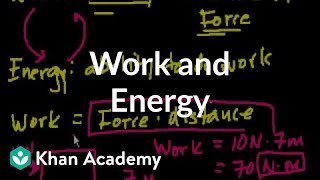
Work and Energy — AP Physics 1
content

Work and Energy — AP Physics 1

Flipping Physics16 min
Conservation of Energy — Khan Academy
content

Conservation of Energy — Khan Academy

Khan Academy11 min
Energy Bar Charts — AP Physics 1
skill

Energy Bar Charts — AP Physics 1

Flipping Physics8 min
🎱
UNIT 412–18%

Systems of Particles and Linear Momentum

Expand ›

Key Topics

  • Momentum: p = mv (vector)
  • Impulse-momentum theorem: J = FΔt = Δp
  • Conservation of linear momentum (no external net force)
  • Elastic vs. inelastic collisions
  • Center of mass of a system
  • Momentum diagrams

Key Terms

momentum
product of mass and velocity: p = mv (vector)
impulse
change in momentum: J = FΔt = Δp
conservation of momentum
total momentum of a closed system is constant
elastic collision
collision in which both momentum and kinetic energy are conserved
inelastic collision
collision in which momentum is conserved but KE is not
center of mass
average position of mass in a system; system accelerates as if all mass is here
Honors Practice Prompt

Honors problem practice: A 3 kg cart moving at 4 m/s collides with a 5 kg cart at rest. They stick together after collision. (a) Draw a before-and-after momentum diagram with labeled vectors. (b) Calculate the final velocity. (c) Calculate the kinetic energy before and after. (d) Is this collision elastic or inelastic? Justify your answer.

Practice with Dr. Priya →

Curated Video Lessons

Impulse and Momentum — AP Physics 1
content

Impulse and Momentum — AP Physics 1

Flipping Physics13 min
Conservation of Momentum — Khan Academy
content

Conservation of Momentum — Khan Academy

Khan Academy12 min
Collisions — Elastic vs Inelastic
review

Collisions — Elastic vs Inelastic

Crash Course Physics10 min
🌀
UNIT 512–18%

Rotation

Expand ›

Key Topics

  • Rotational kinematics (θ, ω, α) — analogous to linear kinematics
  • Torque: τ = rF sin θ (rotational equivalent of force)
  • Rotational inertia (moment of inertia): I = Σmr²
  • Newton's 2nd Law for rotation: Στ = Iα
  • Angular momentum: L = Iω, conservation of angular momentum

Key Terms

torque
rotational force: τ = rF sinθ (units: N·m)
rotational inertia
resistance to rotational acceleration: I = Σmr²
angular velocity
rate of rotation: ω = Δθ/Δt (rad/s)
angular momentum
rotational analog of linear momentum: L = Iω
lever arm
perpendicular distance from pivot to line of action of force
rotational equilibrium
net torque on object is zero (no angular acceleration)
Honors Practice Prompt

Honors investigation practice: A 1.2 m uniform rod is pivoted at its center. A 10 N force acts downward at the left end, and a 6 N force acts upward at 0.3 m from the right end. (a) Calculate the net torque about the pivot. (b) If the rod has mass 4 kg, what is the angular acceleration? (c) A skater pulls in her arms during a spin — explain why her rotation speeds up using conservation of angular momentum.

Practice with Dr. Priya →

Curated Video Lessons

Torque and Rotational Inertia — AP Physics 1
content

Torque and Rotational Inertia — AP Physics 1

Flipping Physics14 min
Angular Momentum — AP Physics 1
content

Angular Momentum — AP Physics 1

Khan Academy11 min
Rotational Kinematics — Crash Course Physics
review

Rotational Kinematics — Crash Course Physics

Crash Course Physics10 min
〰️
UNIT 64–6%

Oscillations

Expand ›

Key Topics

  • Simple harmonic motion (SHM): restoring force proportional to displacement
  • Spring-mass system: T = 2π√(m/k), F = -kx (Hooke's Law)
  • Simple pendulum: T = 2π√(L/g) (small angle approximation)
  • Period, frequency, amplitude — and what each depends on
  • Energy in SHM: conservation between KE and elastic PE

Key Terms

simple harmonic motion
oscillation where restoring force ∝ displacement; F = -kx
period (T)
time for one complete oscillation (seconds)
frequency (f)
oscillations per second; f = 1/T (hertz)
amplitude
maximum displacement from equilibrium
spring constant (k)
stiffness of a spring: k = F/x (N/m)
restoring force
force directed toward equilibrium, proportional to displacement
Honors Practice Prompt

Honors problem practice: A spring-mass system has mass 0.5 kg and spring constant 200 N/m. (a) Calculate the period of oscillation. (b) If the mass is doubled, what happens to the period? Show using the equation. (c) A student claims the period depends on amplitude — is this correct? Justify your answer using the physics of SHM. (d) At what point in the oscillation is the speed maximum?

Practice with Dr. Priya →

Curated Video Lessons

Simple Harmonic Motion — AP Physics 1
content

Simple Harmonic Motion — AP Physics 1

Flipping Physics13 min
Springs and Pendulums — AP Physics 1
content

Springs and Pendulums — AP Physics 1

Khan Academy10 min
Oscillations — Crash Course Physics
review

Oscillations — Crash Course Physics

Crash Course Physics9 min
💧
UNIT 76–12%

Fluids

Expand ›

Key Topics

  • Pressure: P = F/A and P = P₀ + ρgh (pressure with depth)
  • Buoyancy and Archimedes' Principle: F_b = ρ_fluid · V_submerged · g
  • Continuity equation (conservation of flow): A₁v₁ = A₂v₂
  • Bernoulli's Principle: faster flow → lower pressure
  • Floating vs. sinking conditions

Key Terms

pressure
force per unit area: P = F/A (pascals)
buoyant force
upward force on submerged object = weight of displaced fluid
Archimedes' principle
buoyant force equals weight of fluid displaced by the object
continuity equation
A₁v₁ = A₂v₂ — fluid speeds up where pipe narrows
Bernoulli's principle
faster-moving fluid has lower pressure (conservation of energy)
fluid density
mass per unit volume of a fluid: ρ = m/V (kg/m³)
Honors Practice Prompt

Honors investigation practice: A wooden block (density 600 kg/m³, volume 0.002 m³) is placed in water (density 1000 kg/m³). (a) Calculate the buoyant force. (b) Does the block float or sink? Justify using buoyant force vs. weight. (c) What fraction of the block is submerged? (d) Water flows through a horizontal pipe that narrows from 0.04 m² to 0.01 m² cross-section. If the speed in the wide section is 2 m/s, find the speed in the narrow section and qualitatively explain what happens to the pressure.

Practice with Dr. Priya →

Curated Video Lessons

Fluid Pressure and Buoyancy — AP Physics 1
content

Fluid Pressure and Buoyancy — AP Physics 1

Flipping Physics15 min
Bernoulli's Equation — Khan Academy
content

Bernoulli's Equation — Khan Academy

Khan Academy12 min
Fluids — Crash Course Physics
review

Fluids — Crash Course Physics

Crash Course Physics10 min
Honors Assessment Structure

Three Assessment Types

Honors Physics rewards students who can think like physicists — solve problems systematically, design investigations, and construct evidence-based explanations. These three assessment types develop each dimension.

Practice with Dr. Priya →
📊~40%

Physics Problem Set

Multi-part algebraic and conceptual problems. Students solve quantitative problems with full work shown, draw diagrams, and write brief justifications. Mirrors the rigor of honors-level mathematical modeling.

Scoring Criteria
· Complete diagram or setup (FBD, energy bar chart, momentum diagram)
· Correct equation identified and applied with units
· Accurate calculation with correct significant figures
· Conceptual justification connecting equation to the physical situation
Honors Tips
Write the general equation before substituting numbers
Include units in every calculation step
Draw the diagram first — it organizes your solution and earns credit
Check: does the magnitude and direction of your answer make physical sense?
🔬~35%

Lab Investigation Report

Complete scientific lab reports for each major investigation. Students state a hypothesis, identify variables, describe procedure, collect and analyze data, create graphs, and draw evidence-based conclusions with error analysis.

Scoring Criteria
· Clear hypothesis with independent and dependent variables stated
· Controlled procedure reproducible by another student
· Properly labeled data table and graph with axes, units, and trend line
· Conclusion connects results to physics principles with error analysis
Honors Tips
State what you are measuring and how — identify your IV, DV, and 3+ controlled variables
Name the measurement instrument for each quantity (meter stick, force sensor, stopwatch)
Sketch the predicted graph shape before collecting data
Error analysis: name a realistic source of error and how it would affect your results
📝~25%

Conceptual Explanation

Written conceptual explanations of physical phenomena. Students describe what is happening in a scenario, explain the cause using a named physics law or principle, and predict outcomes of changes using proportional reasoning.

Scoring Criteria
· Accurate use of physics vocabulary (net force, momentum, torque, etc.)
· Causal explanation: explains WHY, not just WHAT happens
· Reference to a specific physics law or conservation principle
· Consistent and complete — addresses every part of the prompt
Honors Tips
Use precise physics vocabulary — 'net force' not 'total push,' 'momentum' not 'speed'
Always explain the CAUSE: 'X happens because Y' — not just 'X increases'
Reference a specific law by name when making a claim
Avoid contradictions — re-read your answer to confirm words and math agree
Curated for Honors Physics

Practice & Resources

🏛
REFERENCEFREE

CollegeBoard AP Physics 1

Official CED, unit guides, sample problems with scoring guidelines, and AP Classroom practice — excellent for honors-level rigor benchmarking.

Open resource
📂
PRACTICEFREE

Past AP Physics 1 FRQs (2015–2024)

Every past FRQ with scoring guidelines. Use as high-rigor conceptual practice — these align with Honors Physics investigation and problem-solving skills.

Open resource
🎥
HIGHLY RECOMMENDEDFREE

Flipping Physics (Jon Thomas-Palmer)

The #1 algebra-based physics YouTube channel. Conceptual-first teaching with worked examples. Covers every unit in the Honors Physics curriculum.

Open resource
📺
CONTENT REVIEWFREE

Crash Course Physics

Engaging episode-based series covering all physics concepts. Great for visual overview of each unit and building intuition before quantitative work.

Open resource
🎯
FREE PRACTICEFREE

Khan Academy Physics

Free practice questions organized by unit with hints and explanations. Use alongside Flipping Physics for systematic skill building.

Open resource
📚
COMPREHENSIVEFREE

Fiveable AP Physics 1

Complete course review, unit summaries, investigation practice guides, and live study sessions. Excellent for conceptual mastery and problem-solving fluency.

Open resource
📖
TEXTBOOKFREE

AP Physics 1 Essentials (Wolfe)

Dan Wolfe's concise, curriculum-aligned textbook with practice problems at each level. The best algebra-based physics reference for honors students.

Open resource
AI-Powered Progress

16-Week Honors Mastery Plan

Weeks 1–4

Phase 1: Foundation — Kinematics, Forces, and Newton's Laws

  • Master kinematic equations — know when each applies
  • Practice free body diagrams daily — forces with labels and directions
  • Write one conceptual explanation on Newton's Laws per week
  • Watch Flipping Physics Units 1–2 playlists in full
Weeks 5–8

Phase 2: Energy, Momentum, and Conservation Laws

  • Draw energy bar charts for every conservation of energy problem
  • Practice impulse-momentum problems: cart collisions, explosions, force-time graphs
  • Complete one full lab investigation report per unit (hypothesis → error analysis)
  • Work through Khan Academy Units 3–4 practice problem sets
Weeks 9–12

Phase 3: Rotation, Oscillations, Fluids, and Lab Mastery

  • Connect rotational to linear analogs: torque↔force, I↔mass, ω↔v
  • Practice SHM period formulas with proportional reasoning questions
  • Write 2 lab investigation reports under timed conditions
  • Complete 3 full unit assessments to identify weak areas
Weeks 13–16

Phase 4: Mastery Review and Course Consolidation

  • Review all 7 units through the lens of conservation laws (energy, momentum, angular momentum)
  • Revisit every lab investigation and connect results to physics principles
  • Work through conceptual explanation sets with Dr. Priya (SofAI chat)
  • Final review: proportional reasoning across all units — predict outcomes without a calculator
Agentic AI Tutoring

Your Honors Physics AI Tutor

Dr. Priya Sharma is your Honors Physics expert — every concept, lab investigation, and problem-solving strategy. SofAIconnects Physics to every other subject you're studying.

📐 Walk me through how to draw a perfect free body diagram for a block on an inclined plane⚡ Explain conservation of energy with an energy bar chart — I keep getting confused🔬 Help me write a lab investigation report for a spring-mass oscillation experiment🌀 I always struggle with torque problems — explain the lever arm method step by step
⚡

Ready to Master Honors Physics?

Enroll in the most comprehensive, AI-powered Honors Physics course available. WASC accredited. UC A-G Section D approved. Full Year · Honors Credit.

Browse All Courses

WASC Accredited · UC A-G Approved · Honors Credit · Full Year

Financial literacy should belong to everyone

Help California students build money confidence.

Give to the endowment →Open financial literacy hub
VR
The VR School

The world's first accredited Spatial Intelligence school. WASC-accredited. UC A-G approved. 402+ students. 20+ countries.

520 Lasuen Mall #200, Stanford, California, CA 94309
(650) 422 9180
admissions@thevrschool.org
WASC Accredited

Fully Accredited for Grades 6–12 by ACS WASC

Code: 43 46070 999Grades 6–12

World Labs Partner ✦

Spatial Intelligence · Marble · Spark.js

School

  • About Us
  • Staff
  • Accreditation
  • School Profile
  • Endowment
  • Corporate Giving
  • Careers

Programs

  • UC A-G Courses
  • California Personal Finance
  • CVC Dual Enrollment
  • CVC Pathway OS
  • iBuildme
  • iBuildme App
  • iTeachXR LMS
  • AP Seminar Studio
  • Credentials
  • AI Program
  • VR Labs
  • VR Experiences
  • VR Network

Spatial Intelligence

  • Spatial Lab ✦
  • Moonshots TV
  • World Labs Marble ↗
  • The School That Shouldn't Exist
  • Website Evolution Archive
  • Media & Stories
  • VR Explorer

Support

  • Help & Support
  • Contact
  • Blog
  • Headset Safety
  • Privacy Policy
  • Terms of Service

© 2026 The VR School · All rights reserved · Spatial Intelligence Lab ✦

402+ students · Stanford · Palo Alto · China · Singapore

91% Math · 89% Science · 86% ELA · WASC · UC A-G